
Scaffolding, also known as falsework, is a temporary structure used to support work crews and materials during construction, maintenance, cleaning, and repair. Scaffolding is also used to distribute the weight and load in shuttering, shoring and forming in concrete slabs and beams.
Using scaffolding materials, you can form an access system and work platforms for elevation works. You can also establish support for grandstands, concert stages, and other structures.
There are various types of scaffolding materials used in construction. Include tubes and clamps, frame scaffolding, and a modular scaffold system, such as ringlock, cuplock, Kwikstage, Quicklock, or the Crab 60 shoring system.
Safety is the most critical factor for the construction scaffolding. Scaffolding material, design, arrangement and assembly need to follow scaffold standards and regulations, including OSHA, ANSI(USA Regulations), CSA(Canada Standards), BS(British Standard), EN(Europe Standard) and JIS(Japanese Standard), SS(Singapore Standard), MS(Malaysia Standard), SANS(South Africa Standards) etc. Oil and Gas Companies also have their own scaffold standards, such as KNPC standards, KOC standards, the Saudi Aramco Safety Handbook, and Shell’s DEP standards, among others.
Construction Scaffold Parts and Components
As a whole, construction scaffolding parts include standards, ledgers, truss ledgers (bridge ledgers), transoms, braces, planks, base plates, top plates, toeboards, ladder beams, guardrails, scaffold brackets, ladders, and stairs.
Scaffolding Standards
Scaffolding verticals are the uprights or vertical poles used in scaffolding construction. They are also called scaffold standards; they transfer the entire weight of the structure to the ground and rest on base plates to spread the load.


Scaffolding Ledgers
scaffolding ledgers are horizontal tubes that connect the scaffold standards and provide horizontal support for the scaffold structure. They can run horizontally along the length and width of the scaffold and support the scaffold platform.


Truss Ledger
The Truss ledger has the same function as the standard scaffold ledger but with reinforced tubes and profiles under the standard single ledger, which can take a higher load from the work platform in construction and interconnect with scaffold standards. Truss ledgers are also called double ledgers or bridging ledgers.


Scaffold Transoms
A Scaffold transom is a horizontal component used to support scaffold boards and decks in the structure and take loading bearings from the platforms. It can be made of tubes or angle bars.
An intermediate transom is a type of scaffold transom that offers extra support to the scaffold platform in the intermediate place between scaffold transoms and ledgers.


Scaffold Braces
Scaffold braces are scaffolding components used to secure scaffold verticals together in a square and align to keep the scaffold structure plumb. They can resist sway forces resulting from horizontal loads imposed on scaffolds by wind and worker movement.


There are three types of scaffold braces
Diagonal Braces
Diagonal braces are essential bracing parts set on the outside facing of the scaffold structure to keep the scaffolding in place and keep the scaffold structure stabilised, stiffened, rigid, and won’t rack and sway. A diagonal brace is also called a vertical brace or face brace.
Horizontal Braces
Horizontal braces are the scaffolding components that keep each scaffold unit in the square, normally parallel to the ground. They can keep a single scaffold unit in a fixed position, creating rigidity in each horizontal plane. In scaffolding, the horizontal brace is also called a plan brace.
Cross Braces
The cross brace is a necessary part of frame system scaffold. When opening, they are X shape. In construction, the cross braces are locked on the lock pins of the scaffolding frames and form the scaffold structure. The frame scaffold system has tubular and angular types of cross braces.


Scaffold Planks
Scaffolding planks are scaffold components used to form scaffold platforms, called scaffold boards or scaffold decks.


Scaffolding planks include timber, steel boards, full aluminium planks and aluminium-plywood(alu-ply) scaffold planks.
Timber scaffolding planks
Timber planks are made of wood, including solid wood and LVL wood planks. In construction, they are fixed by scaffolding board clamps. They conform to OSHA, BS2482, and AS1577 standards.


Steel Scaffold Planks
Steel planks, also called steel boards or metal decks, are made of steel. In construction, steel boards can be supported by hooks that sit on scaffold ledgers. The angle type or omega scaffold transom supports steel boards without hooks. Steel boards are conformed to EN1004 and EN12811 standards.


Aluminium Scaffold Plank
aluminium planks are made of alumimium. Aluminium planks are light weight but expensive. Aluminium planks can be hatched with trapdoors that are convenient to access. Aluminium scaffold plank includes a width range from 19″ to 24″.


Aluminium Plywood Scaffold Planks
Aluminium plywood scaffold planks are also light weight but cheaper than full aluminium planks. Hatched trapdoor aly-ply planks are the most popular used for scaffold access and climbing, while 19″ alu-ply planks without hatches are used for frame scaffolding and ringlock systems.


Scaffold Base Plate
scaffold base plates are flat and square steel plates with central spigots or socket tubes used to provide a stable and solid foundation for scaffold structures and support scaffolding standards, evenly distributing loading weight from scaffold structure.
The scaffold base plate functions like scaffolding feet, increasing the surface area of the scaffold’s contact with the ground during construction. This helps the scaffolds remain stable and prevent sinkage.
There are three types of scaffold base plate: fixed base plate, adjustable base plate and swivel base plate in the construction scaffolding.
Fixed Base Plate
Fixed base plates are base plates with non-threaded central tubes. They are fixed and not able to adjust to different heights.


Adjustable Base Plate
adjustable base plate with a central screw tube and a handle nut(jack nut). They can be adjusted to different heights in construction and support. The adjustable base plate is also called an adjustable base jack, screw jack base, scaffold levelling jack or adjustable scaffold feet.


Swivel Base Plate and Jacks
A swivel base plate is a scaffold base plate used for inclined surfaces (sloping ground or pitched roofs). It allows the central tube or threaded rod to swivel to match the sloping ground and roofing.


Scaffold Top Head
Top heads are fixed (with tube or steel stripes at the centre) or adjustable(with jack stem at the centre) heads that are installed at the top of the scaffolding verticals receiving formwork timber beams, aluminium or steel beams in the shuttering.
There are three types of top heads in scaffolding construction. Fork Head (Crosshead), U head and J Head
Fork Head Scaffold
A fork-head scaffold is also called a crosshead or four-way U-head. It has four vertical forks on the plate to receive scaffold beams from different directions. It is convenient in concrete and formwork. Both fixed forkhead and adjustable forkhead jacks are available.


U Head Scaffold
U Head scaffolds are the top head with a head in the shape of “U” and flanks of the same height at both sides. They are the most common top heads in scaffolding construction. U-head scaffolding includes fixed U-head and adjustable U-head scaffolding jacks.


J Head Scaffold
J head scaffold is similar to U head scaffolding, but the flanks are at different heights.
Scaffold Toe board
Toe boards are timber or steel board parts placed around the work platform and attached to the work surface at a right angle. In construction, the purpose of the scaffold toe boards is to protect tools, materials, equipment, or other objects from falling onto people from the edge of the work platform.


Scaffold Ladder Beam
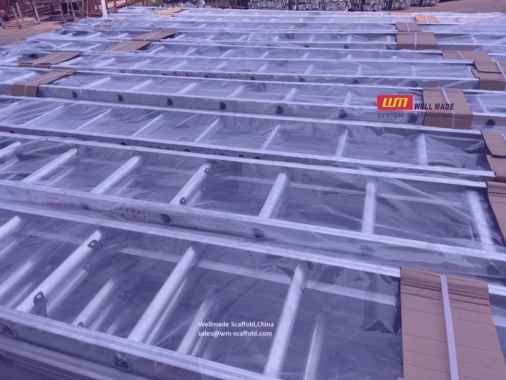
scaffold ladder beams resemble a ladder with OD48.3mm diameter top and bottom chords and OD48.3mm vertical tubes in 305mm standard centre-to-centre, offering openings for the passage of vehicles, workers, materials, and equipment on construction sites. Scaffold ladder beam sizes are 1m to 10m long. Scaffold ladder beams are made of steel scaffold tubes in OD48.3×3.2mm or OD48.3×4.0mm.


Scaffold Guard Rails
Scaffold guard rails are tubular horizontals along the exposed sides of work platforms to reduce the risk of workers or objects falling and slipping off the edge. They include single guardrails and double guardrails. They are secured to lock pins or locks on the construction scaffolding’s vertical parts (guard rail posts or verticals).


Scaffold Brackets
Scaffold brackets are usually prefabricated steel scaffold parts in triangles. They are attached to the central scaffold to support scaffold boards, forming a work platform that extends the scaffold’s working surface and allows workers to get right up against the wall in construction, masonry, and maintenance. Scaffold brackets include side brackets and end brackets.


Scaffolding Ladder
Scaffold ladders are scaffolding components used to climb up and down between the scaffold platforms and grounds in construction, attached to or leaning on the scaffold structure. They normally have two vertical rails and sets of horizontal rungs. Scaffold ladders are made of metal, fibreglass, or wood. Metal ladders, such as steel and aluminium ladders, are most commonly used.


Scaffold Stairs
Scaffold stairs are prefabricated scaffold parts with stringers and staircase treads for scaffold tower access. Scaffold stairs are a safer alternative to ladders, allowing you to move freely and be more productive and more stable in accessing different levels and platforms in construction. Scaffold stairs can be steel stairs or aluminium stairs.


Construction Scaffolding Types
Single Scaffolding
Single scaffolding is scaffolding only with one row of vertical poles and putlogs inserted or tied in the holes of the walls to support the work platform. The single row of vertical poles is parallel to the wall structure and fixed by putlogs, ledgers, and bracing. Single scaffolds are used for simple brick masonry and can be built to a maximum height of 20′ or 6m. They are also called putlog scaffolding or bricklayer scaffolding.
Double Scaffolding
Double scaffolding is scaffolding with two rows of verticals fixed by ledgers, transoms, and braces between them. It is an independent scaffold that does not necessarily insert holes in the wall and can be used for high construction. Compared to single scaffolding, double scaffolding is popular for mansory, building, and facade construction.
Supported Scaffold
The supported scaffold is scaffolding that is not suspended by a rope. It is built on firm, rigid ground and forms platform supports and scaffold structures by poles, frames, ledgers, braces, brackets, boards, and outriggers. It can take substantial weight.
The most common types of support scaffold include tube and coupler scaffolding, frame scaffolding, ringlock, cuplock and kwikstage, cantilever scaffolding, facade scaffolding, shoring scaffold, trestle scaffolding, mobile scaffolding, and roofing scaffolding.
Suspended Scaffold
The suspended scaffolding involves platforms and baskets hung from an overhead structure by ropes, cables, motors, stirrups, or metal chains rather than being installed from the ground. It offers easy and fast access to medium and tall buildings for cleaning, painting, maintenance, and signage.
Residential Scaffolding
Residential scaffolding is a temporary structure erected around a residential building during construction, renovation, or maintenance work, such as housing or private homes. It is not very high and not very large in scale.
Industrial scaffolding
Industrial Scaffolding is a type of scaffolding for industrial projects with features of large scale, complex environment, harsh conditions, and heavy load bearing. It is designed for heavy-duty, efficient access to elevated areas under complex environments safely, including factories, offshore, refineries, tanks, chemical plants, and power station construction scaffolding.
Commercial scaffolding
Commercial scaffolding is scaffolding structures and frames used in commercial construction or commercial building maintenance, such as office buildings, skyscrapers, retail stores, restaurant construction, high-rise commercial building maintenance, and shipbuilding. These are big-scale constructions with more complex environments. Commercial scaffolding needs to be efficient and easy to access.
Infrastructure Scaffolding
Infrastructure scaffolding is scaffolding used for infrastructure and utility projects such as bridges, highways, tunnels, overpasses, wind farms, airports, ports, waterways, reservoirs, dams, police stations, colleges and schools, rails, and roads.
Building Scaffolding
Building scaffolding is scaffolding structures with access and work platform setup surrounding buildings in construction, not that for shoring and concrete support.
Marine scaffolding
Marine scaffolding is scaffolding designed for a marine environment, whether shore-based (docks, piers, dry docks) or for shipbuilding scaffolds for vessel construction and ship repair. It is also called ship scaffold.
Offshore scaffolding
Offshore scaffolding is erected around a structure at sea or some distance from shore to allow workers to access various parts of the structure for construction, repair, and maintenance. It is also called oil rig scaffolding, and it is mainly used for oil rigs.
Oil Gas Scaffolding
Oil gas scaffolding is also called refinery scaffolding, It is a type of scaffolding material designed especially for oil and gas rigs and refineries work that supports workers to start and complete rigs and refinery projects, offers access to hard-to-reach areas such as offshore oil platforms or rectification columns in refineries, for tasks such as painting, insulation, installation, maintenance, inspection for equipment and lines or support piping tubes, racks during assembly. Oil gas scaffolding can be a support scaffold or suspended scaffolding.


Roofing scaffolding
Roof scaffolding is a type of scaffolding designed for accessing work areas on pitched or sloped roofs. It is typically used during roofing renovation and maintenance projects. It can be positioned on the ground, on top of a building, or as an extension of scaffolding surrounding a building.
Chimney Scaffolding
Chimney Scaffolding Chimney scaffolding is specifically designed to help workers reach the chimney for repairs and work. This type of scaffolding may include chimney brackets, ladders, and suspended scaffolding.
Events and Stage scaffolding
Event and stage scaffolding refers to the structural frameworks designed for various events, such as concerts, sports events, political rallies, fashion shows, festivals, and public speeches, whether held indoors or outdoors. These scaffolds must be highly reliable, stable, and capable of supporting heavy loads. They also need to be weatherproof and securely constructed due to the public nature of these events and the potential risks involved. Typically, event and stage scaffolding can incorporate materials such as aluminium scaffolding, hot-dip galvanized modular scaffolding and plywood panels.


Bridge Scaffolding
Bridging scaffolding is specifically designed for the construction and maintenance of bridges. This includes structures such as bridge stair tower scaffolds, bridge pier scaffolds, and custom underdeck bridge scaffolds. These scaffolds provide a stable platform for workers and materials, allowing safe access to elevated and large-span areas.
Bridging scaffolding is characterized by its heavy load-bearing capacity, enabling it to support significant loads from extensive platform and roof spans. It encompasses both supported and suspended scaffolding options.
Tank Scaffolding
Tank scaffolding is a scaffold structure placed inside and exterior along the tank wall to support scaffold platforms and accesses for maintenance, inspection, and other works on storage tanks. Good tank scaffolding provides workers with access to all areas of tanks. Typically, tank scaffolding is curved or round and suited for oil tanks, water tanks, and storage tanks. It must prioritize safety, efficiency, and durability while also ensuring easy access for workers.
Boiler scaffolding
Boiler scaffolding is a specialized scaffolding structure designed to provide access to all areas of both the interior and exterior of boilers in power plants. It is used for cleaning, maintenance, inspections, and other tasks. This scaffolding must withstand extreme conditions, including sparks and fires.
Masonry Scaffolding
Masonry scaffolding is a framework constructed using step frames, cross braces, and scaffold planks. The step frame, also known as a ladder frame, features two or three rungs on one side of the frame for scaffold plank rest. This type of scaffolding is commonly referred to as mason frame scaffolding.
Multi-Function Scaffold
Multi-function scaffolding is a narrow frame stacked up to three tiers high. It features castors and work platforms, making it portable and easy to roll even in tight spaces.
This type of scaffolding is adjustable in height and can be easily assembled by one person. It is versatile and used for various tasks, including painting, maintenance, electrical work, window and skylight washing, and drywall installations.
Multi-function scaffolding is also known by other names, such as baker scaffolding, multi-purpose scaffolding, Perry scaffold, and narrow scaffold.


Slab Scaffolding
Slab scaffolding is a temporary support structure used to hold concrete slabs and beams in formwork during the pouring and curing of concrete until the fresh concrete gains sufficient strength for construction. It can be adjustable in height(using telescopic props) or constructed with a fixed height(shoring frames, etc.).


Facade Scaffold
Facade scaffolding is a scaffold structure specifically designed for work on building facades. It provides support for workers and materials while they work at height, incorporating features such as access stairways and work platforms. Safety elements, including toe boards and guard rails, are also essential components. This type of scaffolding is utilized for various applications, including cleaning, construction, painting, restoration, insulation, roofing, maintenance, and repair. It ensures proper load-bearing capacity and side protection for enhanced safety. Common types of facade scaffolding include the Ringlock system scaffolding and European frame scaffolds of Layher Speedyscaf and Plettac Frames.


Birdcage Scaffold
A birdcage scaffold is an independent scaffold that features a cage-like enclosed structure. It has a broad platform and edge bays designed to minimize the risk of falls for workers during elevated tasks, particularly for large projects involving ceilings, soffits, rooftops, and steelworks. Birdcage scaffolding typically consists of two or more rows of standards and fully boarded top scaffold lifts, providing easy access across different levels of the scaffolding. This type of scaffold is versatile, safe, and easy to assemble, making it primarily suitable for commercial applications.
Tower Scaffold
Tower scaffolding is a freestanding structure consisting of one bay in length and four standards or two frames. Outriggers or stabilizers are needed for stability for heights exceeding certain limits.
These scaffolds are easy to assemble, portable, and provide excellent access for elevated work. They can be constructed from materials like steel, aluminum, or fibreglass. Fibreglass scaffolds are non-conductive, making them suitable for high-voltage areas, while aluminum scaffolds are lightweight and commonly used.
Tower scaffolding can be non-rolling (static) or mobile (with casters for easy movement). Various types include stair towers, cantilever towers, and narrow or double-width towers.


Shore Scaffold
A shore scaffold, also known as a shoring scaffold, is a temporary support system designed to prop up structures and bear loads during modifications, renovations, repairs, demolitions, or alterations. It also supports formwork until the wet concrete sets and becomes stable during construction, helping formwork panels withstand the pressure exerted by wet concrete until it cures.
Shore scaffolds typically include vertical shoring, often called falsework, and horizontal or angled shoring. They are generally heavy-duty scaffolding materials made from modular steel, allowing them to support substantial concrete loads.
Heavy Duty Scaffold
According to OSHA standards, a heavy-duty scaffold is rated as having a platform workload up to 75 pounds per square foot (about 366.15 kg per square meter). In EN12810 and EN1004 standards, heavy-duty scaffolding (work platform) can support loads up to 3.00 kN per square meter.


Hi Load Scaffold
Hi-load scaffolds are typically designed for high-weight-bearing applications, particularly in shoring for concrete construction. These scaffolds usually comprise scaffolding systems featuring verticals with an outer diameter of 60mm. Common types of hi-load scaffold systems include the shoring frame system, the crab 60 shoring scaffolding system, and the 60mm Ringlock shore system, which has an ultimate load of scaffold tower (4 legs and three tiers) more than 60 kN per set. Hi-load scaffolds are used for large-scale and high-scale scaffolding construction.
Medium Duty Scaffold
A medium-duty scaffold is designed to take an intended load of up to 50 pounds per square foot(244.1 kg per square meter). It is a regular scaffold that takes weight and loads workers and tools, material in bricklayers, plasterers, masonry, etc.
Light Duty Scaffold
A light-duty scaffold is designed to take a work platform load of up to 25 pounds per square foot (122.05kg per square meter). Carpenters, painters, and workers often use it on simple, lower-height jobs.
Self-climbing Scaffolding
Self-climbing scaffolding is a type of scaffold system that is integrated once and lifted by hydraulic rams, automatically and efficiently reaching different height levels of construction. It is suitable for high-rise buildings or high-rise wall structure constructions, eliminating dangers and speeding up work progress for high-rise construction projects.
How to Choose Scaffolding for Your Construction
14 Factors You Need to Know In Your Construction Scaffolding Selection
When selecting scaffolding, it is crucial to consider the following 14 key factors.
Scaffold Product Standards and Scaffolding Safety Rules In Your Country
Most countries have their own scaffolding standards:
- USA scaffolding standard is OSHA & ANSI
- The Canadian scaffolding standard is CSA S269.2- 16.
- UK standard is BS1139, EN12810 EN74
- European standard is EN12810 and EN12811
- Australian and New Zealand Scaffolding standard is AS/NZS 1576
- Malaysian standard is MS1462
- Singapore standard is SS 280
- Japaninese standard is JIS 3444 and JIS A 8951
- Korean standard is KSD3501
- South African standard is SANS 1008
Before choosing scaffolding, consider which scaffold standard you prefer. Typically, BS1139, EN 12810, OSHA, and AS1576 are the most widely accepted scaffold standards among most countries.
If you want special products, such as steel props, the standard is EN 1065. The hot dip galvanising standard is EN ISO 1461. The aluminium ladder standard is EN 39. Scaffold board standard could be EN 12811 or EN 1004. The standard for timber boards is BS 2482 and OSHA, AS 1577.
When selecting scaffolding materials, ensure that the scaffolding complies with the standards in your country.
For example:
- In the UK, cuplock scaffolding, kwikstage, tube and clamp scaffolds are commonly used
- In Australia, the kwikstage scaffold is widely used
- In the USA, ringlock (pinlock) scaffolds, cuplock, walk-through frames, masonry frames, shoring frames, and twistlock scaffolds are commonly used.
- In Malaysia, traditional frame scaffolding is not permitted according to the Malaysian CIDB, but crab 60 scaffolding, ringlock scaffolding, and tube clamp systems are commonly used.
- In Gulf countries, ringlock, cuplock, kwikstage, and tube clamp systems are used the most commonly.
- In Singapore, ringlock, cuplock, frame scaffolding, BS 1139 scaffold tubes and clamps, as well as JIS standard pipe and JIS/Korean standards fittings, are all permitted for use. Additionally, the high-load Crab 60 shoring system is also approved.
- In South Africa, the Kwikstage scaffold is widely used.
Scaffolding Load Capacity of Your Project and Safety Factors
When choosing scaffolding, it is essential to determine the maximum weight it will need to support during construction.
If the scaffold is used for concrete shoring, the required load may be very high, depending on the thickness of the slab and beam. Thus, heavy-weight bearing scaffolding, such as the Crab 60 scaffold, OD60mm Shore Ring System, and Hi-Load Shoring Frames or formwork frames, V shore frames, is essential to choose.
If the construction is used to surround buildings and structures for access and work platforms, you can choose a heavy-duty scaffold, a medium-duty scaffold and a light-duty scaffold as your construction scaffolding. Under these cases, typically, ringlock scaffolding, cuplock scaffolding, and kwikstage scaffolding can be used for both heavy-duty and medium-duty scaffolding. Light-duty scaffolds can be equipped with aluminium scaffold towers or frame scaffolding (such as ladder frame, H frames, walk-through frame, etc.).
For safety considerations, when calculating scaffolding safety workload, safety factors must be taken into account. The safety factor is usually a 2:1, 2.5:1, 3:1 or 4:1 factor if no special requirements are specified.
What is the Height of Your Scaffolding Project
When selecting scaffolding for your project, it is essential to determine the height of the scaffolding.
Safety is the top priority in scaffolding construction.
Scaffolding Safe Working Load (SWL) = scaffolding ultimate load(three tiers) x safety factor (The typical safety factors for scaffolding are 1:3 or 1:4. That means the ultimate load divided by 3 or 4 is the safety working load)
The safety working load needs to be higher than all possible weights the scaffolding needs to bear, including the self-weight of the scaffolding materials, tools, and personnel, as well as external factors such as wind and snow loads. Higher scaffolding requires a greater load capacity because it carries a heavier self-weight and is subjected to more significant environmental forces.
For tall scaffolding, it is advisable to use heavy-duty steel options, such as ringlock, cuplock, and Kwikstage systems, as well as shoring systems like 60mm Ring Shore, Crab 60, and shoring frames. Additionally, high scaffolding should be designed by professional engineers who can incorporate more diagonal braces and ledgers to distribute the load more effectively and enhance stability by securing it to buildings or structures.
It’s also important to consider the time requirements of end-users; opting for modular scaffold systems can help increase the efficiency of both erection and dismantling.
For low scaffolding, you can choose standard masonry scaffolding, tube clamps, or aluminium scaffold towers, which are lightweight, easy to move, and convenient to set up wherever needed.
What is Your Budget for the Scaffolding
When selecting scaffolding, it is essential to consider your budget for the investment. Steel scaffolding is generally more affordable than aluminium scaffolding. Among steel scaffolding options, the traditional tubular scaffolding, comprising scaffold tubes and clamps, is the most cost-effective type, particularly the Japanese standard tube and clamp scaffold.
While steel modular scaffolding is more costly than the tube and clamp system, it offers greater efficiency in terms of erection and dismantling. If your budget is decent but not enough for hot-dip galvanised steel modular scaffolding, you might consider painted, powder-coated, pre-galvanised, or electro-galvanised (cold galvanised or zinc-plated) steel scaffolding. These options allow for quick and easy assembly while remaining budget-friendly.
If your budget permits, hot-dip galvanised steel scaffolding is the best type of scaffolding. It is typically cheaper than aluminium scaffolding, has a high load-bearing capacity, and boasts a long lifespan. Although aluminium scaffolding is more expensive, it is durable, easy to store and transport, and well-suited for mobile scaffolding applications.
How long will it take you to Finish The Project?
When selecting a type of scaffolding, it is essential to have a clear understanding of the project schedule. How much time is allotted for the scaffolding work? If you need quick scaffolding solutions with minimal training time, modular scaffolding and frame scaffolding are excellent options.
In particular, the Crab 60 modular scaffold features triangle frame components that allow for the quickest assembly. This means you can erect it once and easily relocate it without needing to dismantle and reassemble it. Additionally, the Crab 60 shoring system, featuring 60mm diameter verticals and S355 high-strength steel grade, is designed for heavy-duty loads, making it suitable for various jobs and weight requirements.
If your scaffolding project is expected to last longer, consider using hot-dip galvanised steel scaffolding or aluminium scaffolding, depending on the load and height requirements.
What is the Available Space for Scaffolding Construction?
It is essential to consider the construction site when choosing scaffolding. Is the space enough to erect a standard scaffold, or will you need suspended or foldable scaffolding due to limited space?
What is the Weather and Environment At The Construction Site?
The weather conditions and environment at a construction site are crucial factors in selecting the appropriate type of scaffolding.
If the scaffolding will be used on an island near the sea, it is essential to choose hot-dip galvanised steel scaffolding. In areas with frigid and wet temperatures, it is also crucial to use hot-dip galvanised steel scaffolding. This includes ensuring that the couplers, as well as small components such as bolts and nuts, are also hot-dip galvanised.
In contrast, in hot and dry regions such as the Gulf countries, painted and coated scaffolding is commonly used because it resists rust and has a longer lifespan in those weather conditions, even with no galvanising.
Do You Want to Repeat Using the Scaffolding, and How Long Will It Take to Repeat?
When selecting scaffolding types, it is essential to consider how frequently you will need to use the scaffolding for repeat construction. If the scaffolding will be used repeatedly across different construction sites, opt for more versatile options that can accommodate various types, shapes, heights, and load capacities. In this case, it is essential to choose a heavier, more durable, and sturdy scaffold that can withstand repeated transportation, erection, and dismantling without becoming rusty or deformed over time. This scaffold should also be safe for use on both high and low scaffolds simultaneously. Suitable options include steel tubular scaffolding, ringlock scaffolding, kwikstage scaffold, shoring frames, Euro frame scaffolds, and cuplock scaffolding. Hot dip galvanising is essential for repeated steel scaffolding.
For smaller projects or indoor use, aluminium scaffolding, folding scaffolds, and baker scaffolds are excellent choices for repeat usage.
Are Your Scaffolding Construction Sites and Projects Under a Special Environment?
If your construction site is located near a power substation or in a petrochemical environment, you cannot use metal scaffolding—either steel or aluminium—as well as wood scaffolding materials. Instead, you should opt for a non-conductive(insulated) and chemically resistant scaffolding material, such as fibreglass scaffolding (GRP scaffold).
Does Your Scaffolding Construction Need Fire Resistance?
If your scaffolding construction site is located near a fire growth area, select scaffold materials that have fire-retardant treatments, such as fire-retardant planks or fire-retardant safety nets, to mitigate risks from flames.
Is the scaffolding always adjusted to the height? Need adjustable or not
Does your construction project require scaffolding or shoring support for varying heights? If a project requires shoring at varying heights, it is essential to select adjustable scaffolding materials, such as adjustable scaffold props or adjustable scaffold towers.
Which Scaffolding are you Familiar with in your experiences
The same construction project can utilise different types of scaffolding. You can choose whichever type you are familiar with, or one similar to the scaffolding you know, as long as the load capacity and safety meet the requirements of your project’s height and conditions.
Does Your Scaffolding Construction Site Have Uneven or Sloppy Ground?
Scaffolding can be used on uneven or sloped ground, but specific considerations are necessary to ensure stability. In these conditions, it is essential to use an adjustable base jack (also known as scaffold leg feet) for uneven surfaces and a swivel base jack for sloped ground. These adjustable scaffolding components enable precise levelling, as they can be extended or retracted to accommodate ground irregularities, ensuring the scaffolding structure remains vertical and stable.
If the ground is soft, it is essential to place a base under the base jacks, such as scaffold sole boards made of timber or plastic. This helps solidify the ground beneath the scaffolding, contributing to overall stability.
What type of Scaffolding Project -Residential, Commercial, Industrial?
When choosing the best scaffolding types, it is also essential to understand the purpose for which scaffolding is used, whether for residential, commercial, or industrial purposes. You need to obtain opinions from an end-user or the contractor regarding any additional requirements for the scaffolding arrangement.
What is the Best Scaffolding
The best type of scaffolding is steel scaffolding, as it meets all six characteristics of good scaffolding:
- Sturdy and safe, capable of bearing heavy weights.
- Easy to assemble.
- Flexible enough to accommodate various construction applications.
- Includes safety features such as work platform guardrails and toeboard systems.
- Easy to design for convenient access to hard-to-reach workplaces, ensuring efficiency and safety.
- Budget-friendly.
- Durable and reusable for many years.
Best Scaffolding For Heavy-Duty Shoring
The best scaffolding for heavy-duty shoring of slabs and beams is steel shoring scaffolding. This includes Crab 60 shoring systems, shoring frames with an outer diameter of 60mm, adjustable steel post shores (telescopic props) from D to E class, as well as a 60mm shore ring system.
Best Scaffolding for Home Use
The best scaffolding for home use is aluminium foldable scaffolding. It is easy to fold up when not in use and simple to set up for work surrounding the house or inside the home. It is also easy to transport by car, making it ideal for home repairs and maintenance tasks. Additionally, Baker scaffolding, a type of mobile scaffold, is also suitable for home use.
Best Scaffolding for Commercial Scaffolding Construction
The best scaffolding for commercial construction is frame scaffolding, particularly walk-through frame scaffolding. It offers quick assembly, enhanced safety, and can allow a sidewalk or pathway beneath, making it suitable for maintenance and repairs even in crowded city centres.
Best scaffolding for industrial construction
The best scaffolding for industrial construction is the steel ringlock scaffold. Ringlock scaffolding is designed for high load capacity, featuring rosettes that connect in eight directions, offering both flexibility and sturdiness. This scaffolding system comprises numerous modular parts, enabling it to meet a wide range of versatile requirements in construction.
Best Scaffolding for Events and Staging
The best scaffolding for events and staging is ringlock scaffolding. The ringlock system features specialized components, including child-friendly guardrails, stage starters, girders, and truss ledgers, which allow for significant distances between two vertical supports. This system is easily compatible with aluminum and plywood decks and is designed to be sturdy, thanks to its 8-direction fixing and connection. Additionally, the hot-dip galvanised finish ensures durability for both indoor and outdoor events and staging projects.
Best Scaffolding for Oil and Gas
The best scaffolding system for the oil and gas industry is the tube and clamp system (EN39/BS1139 standards). This type of scaffold is versatile and can be erected in a variety of shapes and locations during oil and gas construction and maintenance projects. It requires only scaffolding clamps to secure the tubes, making it capable of providing support anywhere needed in the scaffolding construction.
Most Common Scaffolding
The most commonly used scaffolding today is steel scaffolding, which includes tube clamp scaffolding, ringlock scaffolding, cuplock scaffolding, kwikstage scaffolding, frame scaffolding, and scaffolding props.
Strongest Scaffold
The strongest scaffold is the high-load steel shoring system scaffolding, which features a vertical diameter of 60 mm or greater and is made of S355 steel grade. The shoring scaffolding systems include the Crab 60 shoring system, the 60mm ring shore system, and the high-load shoring frame scaffold with an outer diameter of 60 mm. This steel shoring system scaffold has an ultimate load capacity of over 600 kn (for a three-tier tower load).
Takeaway Tips for Construction Scaffolding Choosing
- Universal Scaffold: Tube and Clamp System: This traditional scaffolding can be used for various scaffold types. While it takes more time to set up, it is a budget-friendly option.
- The most commonly used scaffolding types include the Ringlock System, Kwikstage System, Cuplock System, Quicklock System, and Frame Scaffolding, which are suitable for most construction projects. These systems are generally more efficient for erection and dismantling compared to tubular scaffolding.
- Heavy-Duty and High-Load Construction Shoring**: For shoring needs, consider using a shoring scaffolding system, such as the Hi-Load Shoring Frame, Crab 60 Shoring System, or 60mm Ring Shore System.
- Durability for Longevity Scaffolding: Opt for hot-dip galvanised steel scaffolding or aluminium scaffolding to ensure durability over time.
- Adjustable Scaffolding for Shoring: Utilise telescopic props for versatile and adjustable shoring solutions.
- Cost-Effective and Strong Scaffold: Opt for painted or powder-coated steel scaffolding for a more affordable yet robust solution.
- Compact and Convenient Scaffold: For smaller spaces, consider a foldable scaffold or an aluminium scaffold tower.
- Commercial Construction Scaffolding: Consider Ringlock, Cuplock, and Kwikstage Modular Scaffolding for Support, and Aluminium Tower Scaffold for Mobile Work.
- Industrial Construction Scaffolding: Consider Tubular Scaffolding and Heavy-Duty Scaffold.
How To Design and Plan Scaffolding For Construction
Site Assessment
A thorough site assessment minimizes risks, ensures worker safety, and lays the foundation for a successful scaffolding installation. You need to evaluate ground conditions and access points. It must also verify compliance with local construction and safety regulations (E.g. OSHA, ANSI, etc.)
Load Considerations
It is essential that you calculate the maximum intended load for your construction and shoring(including all factors: workers, tools, materials, wind load, etc.)
Scaffolding Type Selection
When you select scaffolding types, you need to know the ultimate load of this scaffold type. It has to ensure the scaffold you selected can bear the intended weight after dividing the scaffolding safety factor by 3 or 4.
Scaffold Height and Dimensions
Define the scaffold height, width and working levels and get a list of the scaffolding you need for your construction.
Scaffolding Assembly Instructions
Preparation
- Clear and Level Ground
- Install Base Plates and Sole Boards
Step By Step Construction
- Assemble the frame or scaffold verticals(standards)
- Add scaffold ledgers(horizontal) and transom to the scaffold standard and form the base scaffold structure
- Install scaffolding planks for work platforms
- Attach scaffold diagonals and braces to keep the scaffold structure stable
- Add Ladders for scaffolding access
- Add guardrails and toe boards for work platform safety protection
Conclusion
Scaffolding is an essential tool in construction, offering support and safety for workers performing tasks at height. Understanding the components, proper installation, and safety regulations is crucial to ensuring a secure working environment.